
Greetings, skin microbiome enthusiasts!
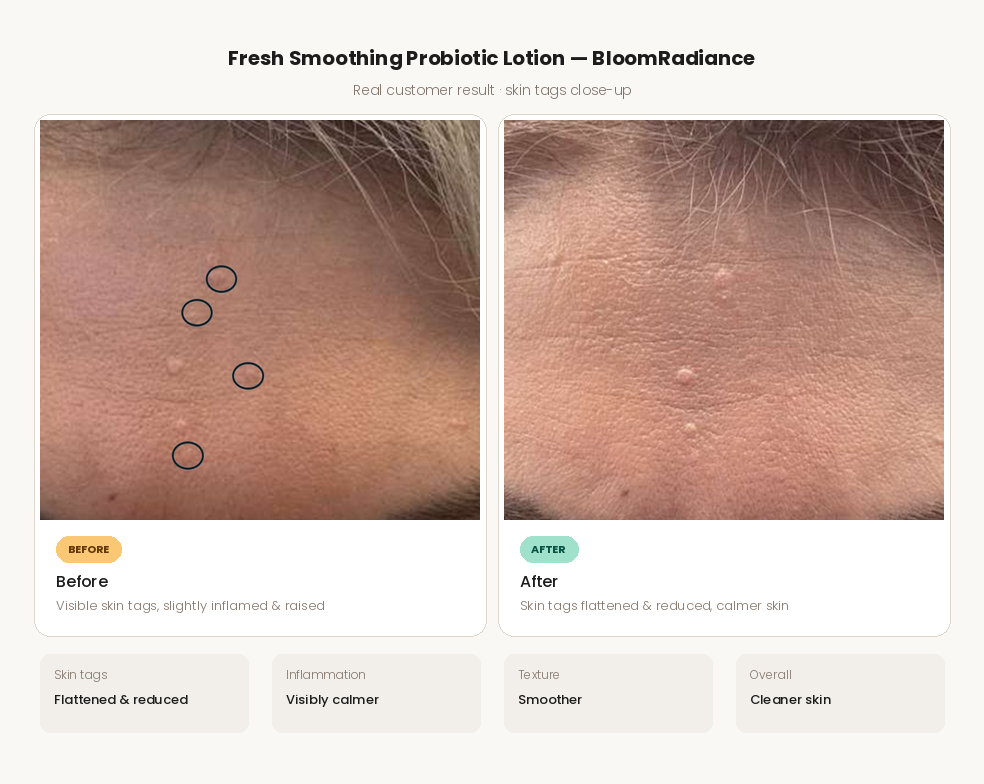
Something interesting has been coming through our customer conversations. Independently and repeatedly, people have mentioned that their skin tags appeared to shrink or become less noticeable while using our probiotic lotions. I have noticed it myself. And as a scientist, I can’t just let that observation sit without digging into the science behind it.
This post is not a medical claim. We are a cosmetic skincare brand, and what our customers are sharing is their personal experience with how their skin looks and feels. But it is worth exploring what we know about skin tags, what science tells us about lactic acid bacteria and the skin, and why this pattern across two different products might be meaningful.
Skin tags, clinically known as acrochordons, are among the most common benign skin growths. According to the National Institutes of Health (ncbi.nlm.nih.gov), approximately 50 to 60 percent of adults will develop at least one during their lifetime, with occurrence becoming more likely after the fourth decade of life. They are soft, small, noncancerous growths that typically appear where skin experiences repeated friction: the neck, underarms, eyelids, and body folds.
Despite how common they are, the exact mechanism behind their formation is not fully understood. Research points to a cluster of contributing factors:
Structurally, a skin tag is composed of collagen fibers and small blood vessels enclosed within skin, typically attached by a thin stalk. They are harmless, but many people find them cosmetically bothersome.
From a medical standpoint, skin tags are treated through physical removal. The most common professional approaches include:
These procedures are generally quick, well-tolerated, and provide immediate cosmetic improvement (Connolly Dermatology, connollyskincare.com). However, because skin tag removal is classified as cosmetic, it is typically not covered by insurance and involves a clinic visit. Home removal products carry real risks, including infection, scarring, and skin injury, and the FDA has issued warnings about over-the-counter removal kits.
The other important point: removal addresses the growth that’s already there, but not the underlying conditions that contributed to it.
Both Fresh Smoothing Probiotic Lotion (BloomRadiance) and Fresh Hydrating Probiotic Lotion (BloomBasis) are cosmetic skincare products formulated to support a balanced, healthy-looking skin environment. They are not intended to treat, diagnose, or remove skin tags.
That said, the pattern customers are describing, skin tags appearing smaller or less visible with consistent use, has us thinking. And as a scientist, I think it is worth exploring the biological mechanisms that could be at play.
Both of our products contain live lactic acid bacteria (LAB) as their active probiotic ingredient. Fresh Smoothing uses Lactobacillus plantarum DSM 6595, and Fresh Hydrating uses Streptococcus thermophilus SD-5207. The base lotion shared by both products also contains Lactobacillus Ferment and Lactobacillus/Nereocystis Leutkeana Ferment Filtrate.
To understand why a probiotic lotion might affect how a skin tag looks, it helps to think about what a skin tag actually is. At its core, it is a small buildup of excess skin tissue, collagen, and skin cells that has grown outward from the surface. It is not dangerous, but it is an area where the skin has lost its normal balance and produces more than it needs.
This is where lactic acid bacteria become interesting. When live probiotic bacteria are applied to skin, they naturally produce lactic acid as a byproduct. Lactic acid is one of the most well-established ingredients in dermatology; it has been used for decades to gently encourage skin cell turnover, meaning it helps the skin shed old cells and renew itself more efficiently (WedMD). Research published in the British Journal of Dermatology confirmed that topically applied lactic acid influences how skin cells behave at a biological level, including how they respond to signals that regulate growth (pubmed.ncbi.nlm.nih.gov/11453900).
Beyond lactic acid, the bacteria themselves appear to support the skin environment more broadly. A study published in Scientific Reports found that lactic acid bacteria applied to skin helped calm localized inflammation and supported the skin’s natural renewal processes (ncbi.nlm.nih.gov/pmc/articles/PMC7360600). A 2024 review in Biochemical and Biophysical Research Communications also found evidence that topical probiotics may help support the skin’s own defense and balance mechanisms, though researchers noted more targeted studies are still needed.
So how might this connect to skin tags? Here is the hypothesis, stated plainly: skin tags are essentially excess tissue sitting on the surface. If consistent probiotic use helps the skin environment rebalance, calming low-level inflammation, encouraging normal cell renewal, and restoring microbial balance on the skin, it is plausible that over time, this could support changes in how that excess tissue looks and feels. We are not claiming the products remove skin tags. But we think this is a reasonable line of thinking, and it is consistent with what our customers are telling us.
Here is what makes this observation particularly interesting: we are seeing it reported across both Fresh Smoothing and Fresh Hydrating. These two products share the same lotion base and the same live probiotic delivery system. Their key difference is the specific probiotic strain used; one product uses a different bacterium than the other.
If customers and I are noticing similar effects with both products despite using different bacterial strains, it suggests that whatever is happening is not unique to one specific microbe. It may be something that lactic acid bacteria share more broadly, most likely the lactic acid they naturally produce, or other byproducts that are common across this family of bacteria.
This is an observation, not a conclusion. We do not have controlled data. We cannot point to a clinical trial. What we have is a consistent pattern emerging organically across our customer base that deserves attention.
Clinical research is extraordinarily valuable, and extraordinarily expensive. Conducting even a basic dermatology study typically starts at around $50,000, and a fully powered trial with the kind of controls, endpoints, and regulatory rigor that would allow definitive claims can run into the millions. For a small science-driven company like ours, that is not something we can take on lightly.
But I dream of a world where this gets studied properly. If live probiotic application, through something as simple as a daily lotion, can support changes in the appearance of benign skin growths through mechanisms like microbiome rebalancing, lactic acid byproduct activity, or immune modulation, that is genuinely meaningful for a lot of people. Skin tags are not dangerous, but they are extremely common, and many people are bothered by them. Safe, gentle, non-invasive options are worth understanding.
For now, we know what our customers are experiencing. We know what we have experienced ourselves. And we know the science of lactic acid bacteria on skin is genuinely interesting territory.
We will keep listening, keep documenting, and keep hoping that one day the data will catch up with what we are already seeing.
These statements reflect customer experiences and have not been evaluated by the Food and Drug Administration. Fafabiotic products are not intended to diagnose, treat, cure, or prevent any disease or medical condition. If you have concerns about any skin growth, please consult a qualified healthcare provider. Individual results may vary.
References
NIH/StatPearls: Skin Tag (Acrochordon) ,https://www.ncbi.nlm.nih.gov/books/NBK547724/
Medscape: Acrochordon Overview ,https://emedicine.medscape.com/article/1060373-overview
Scientific Reports: Lactic acid bacteria and skin health ,https://www.ncbi.nlm.nih.gov/pmc/articles/PMC7360600/
Biochemical and Biophysical Research Communications (2024): Probiotics and skin immunology ,https://www.sciencedirect.com/science/article/abs/pii/S0006291X24001682
WebMD: Lactic Acid for Skin Care ,https://www.webmd.com/beauty/lactic-acid-for-skin-care
British Journal of Dermatology / PubMed: Topical lactic acid and skin cell behavior ,https://pubmed.ncbi.nlm.nih.gov/11453900/
Connolly Dermatology: Skin Tag Removal ,https://www.connollyskincare.com/clinical-dermatology/skin-tag-removal/
Until next blog, cheers
