


Greetings, skin microbiome enthusiasts.
I am probably the most biased person on the planet when it comes to evaluating my own product.
I did not just buy it off a shelf and try it. I conceived it, researched it, formulated it, failed at it multiple times, reformulated it, tested it on myself and my family for months before anyone else touched it, and then built a small manufacturing operation to bring it to life. When you have poured that much of yourself into something, objectivity is the first thing you lose.
So I did something that felt a little uncomfortable at first. I started using AI image analysis to evaluate the before and after photos my customers send me. No labels. No context. I upload both images and ask it to tell me which one came first and what differences it sees.
It does not know which photo is before and which is after. It does not know what the product is. It just looks.
And what it keeps finding is making me feel a little less biased and a lot more confident.
But first, let me tell you what the photos cannot show.
Before I get into the results, I need to say something that I think gets lost in the world of before and after images.
The thing I care most about is not what your skin looks like. It is what your skin feels like.
My ideal image of success has nothing to do with a photo. It is a woman walking out the door in the morning, no foundation, no concealer, no cover-up, and she is not thinking about her skin at all. She is just living her day. Her skin feels like skin. It breathes. It is not tight, not greasy, not reactive. It just feels like hers again.
That feeling is what I formulated for. And it is genuinely the hardest thing to communicate on a website where most people spend less than a few seconds on any given page. You cannot feel a product through a screen. You cannot photograph the sensation of skin that has stopped fighting itself.
Before and after images are a different kind of evidence. They show something real and visible that a stranger can evaluate without context. But they are a secondary language. The primary one is feeling.
How I got into formulation in the first place.
The probiotic part I understood. That was my wheelhouse. I had spent years studying the skin microbiome, decades formulating microbes into stable products for Agriculture, and I knew what I wanted the living biology to do.
What I did not know was how to make a lotion.
I mean that literally. I had to start from the beginning. I researched the difference between a lotion, a cream and a serum. I studied emulsification, viscosity, water-to-oil ratios, emulsifier chemistry, preservative systems, pH balance. I read formulation guides, cosmetic science literature, ingredient safety databases. I made batches that separated. Batches that felt wrong. Batches that smelled off. Batches that looked promising but felt like nothing on skin.
It took close to a year of testing before I felt like I had something real. The challenge was not just getting a product that worked. It was getting a product that delivered probiotics effectively, felt magnificent on skin, was stable enough to survive shipping and storage, and did not contain the kind of broad-spectrum preservative load that would undermine the very living biology I was trying to protect.
That last part was the hardest. And it is the part most people never think about when they pick up a skincare product.
What the images are showing.
Now, back to the photos.
Across the results I have collected, two categories stand out most clearly.
For acne, the results are the most dramatic and the most consistent. Teen back acne, adult hormonal acne around the chin and jaw, and acne across the cheeks. In every case, the images show significant clearing, reduced redness, and calmer skin. The AI analysis consistently identifies these as the strongest results in the library, and I agree. When your skin microbiome is rebalanced and no longer fighting chronic inflammation, acne often resolves as a downstream effect. This is not treating acne in the traditional sense. It is supporting efforts to remove the conditions that allow it to thrive.
For aging concerns, the results are real but more gradual, which is exactly what you should expect from a product that works with your biology rather than against it—Appearance of: Fine lines softening over months. Pores tightening. Skin tone becoming more even. Crepey skin on the neck and hands becoming smoother. Pigmentation fading. These are not overnight transformations. They are the kind of changes that happen when your skin starts doing its own work again.
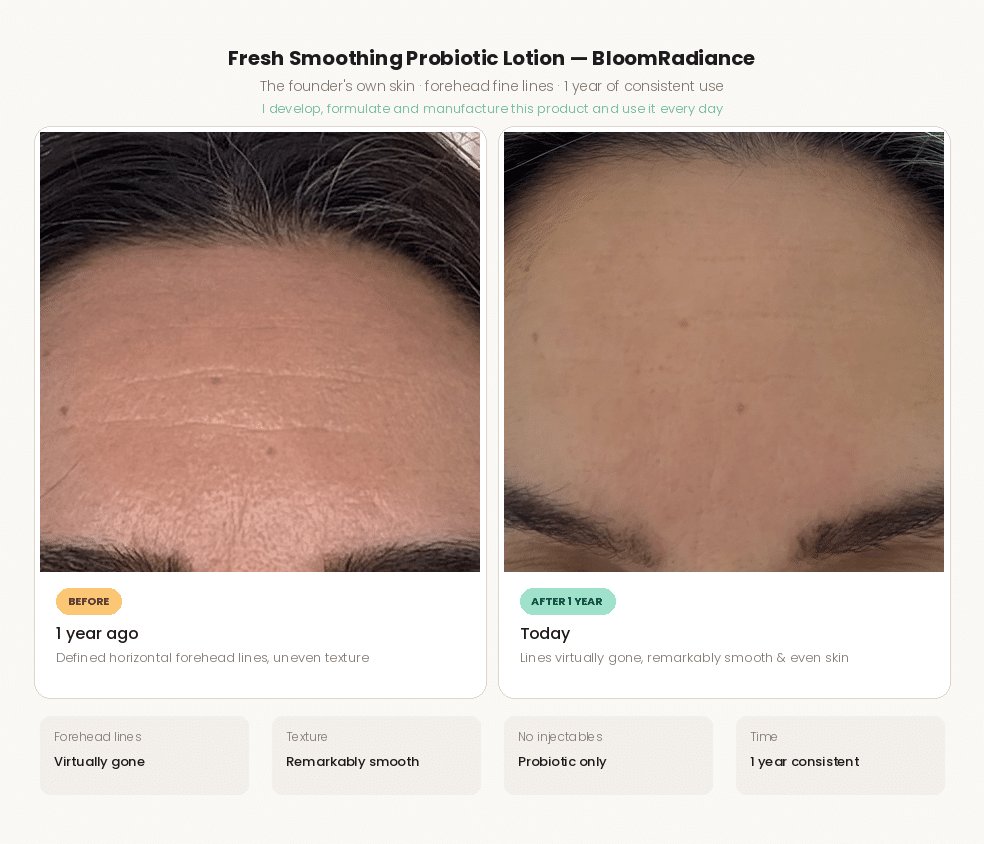
I am also in these photos. My before is from about a year ago. The after is recent. I am not going to claim my forehead looks twenty years younger because it does not and that would not be honest. But the lines are softer, the texture is smoother, and more than anything, my skin feels different than it did a year ago. Better. More like mine.
One honest thing I want you to know.
This product does not work overnight. I say this to every prospect and every new customer because I would rather lose a sale than set the wrong expectation.
It works by supporting your skin from within, and that process takes time. The longer you use it, the better your skin gets. The customers who see the most dramatic results are the ones who stayed consistent for months, not weeks. The ones who trusted the process even when the early days felt subtle.
If you have not seen our customers’ before/after you can check them at these pages after product info:
https://fafabiotic.com/product-category/clear-balanced-skincare
https://fafabiotic.com/product-category/longevity-ageless-skincare
The before and after images you see on this site are not the result of a quick fix. Every single one of them is the result of someone who showed up for their skin every day and gave it time to respond.
That is the only miracle I know how to make.
Until next time, Cheers


